


EzFill Clone App Development
Develop an EzFill-like fuel delivery app featuring multi-fuel support, subscription plans, live driver tracking. A common reference point for US B2C launches.

Comfygen is a leading fuel delivery app development company helping startups, fuel retailers, and fleet operators across the India, UAE, UK, Canada and United States launch on-demand fuel delivery solutions. Our AI-powered fuel delivery app development services are designed to streamline fuel ordering, dispatch, and delivery with advanced automation, real-time tracking, and seamless digital payments for a smooth customer experience.


Comfygen handles end-to-end fuel delivery app development for startups, fuel station owners, and enterprises. Every build is shaped around your model, your permit footprint, and the markets you're opening first.
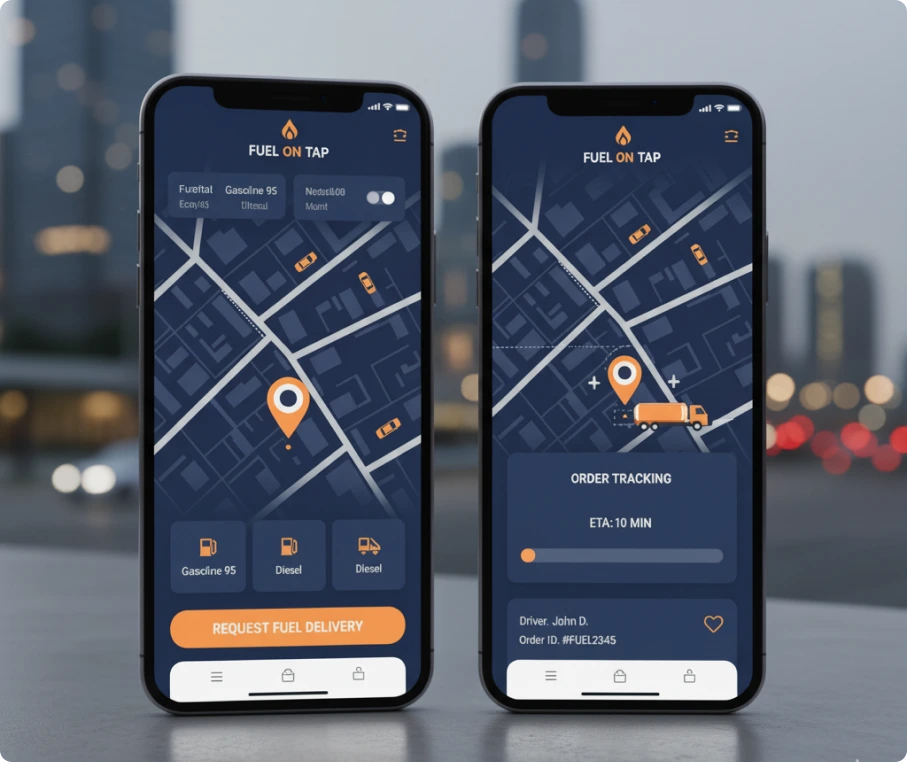
We develop powerful on-demand fuel delivery apps that enable doorstep delivery of petrol, diesel, and gas with real-time driver tracking. Customers pick a fuel type and quantity, drop a pin, and watch the truck arrive. Behind it sits a dispatch system that assigns the closest available driver with enough product on board.
Live delivery tracking with accurate ETAs
GPS route optimization across multi-stop runs
Card, wallet, and fleet-card payments with pre-authorization

We develop powerful on-demand fuel delivery apps that enable doorstep delivery of petrol, diesel, and gas with real-time driver tracking. Customers pick a fuel type and quantity, drop a pin, and watch the truck arrive. Behind it sits a dispatch system that assigns the closest available driver with enough product on board.
Live delivery tracking with accurate ETAs
GPS route optimization across multi-stop runs
Card, wallet, and fleet-card payments with pre-authorization
Launch your own branded fuel delivery app quickly with our ready-to-deploy white-label solutions. Ideal for startups and enterprises, these apps are fully customizable, scalable, and built for rapid market entry.
Full brand control over UI, colors, and store listings
Backend built to handle growing order volumes
Single codebase for both Android and iOS
Built from scratch when your model doesn't fit anything off the shelf. Single-city operators and multi-state networks both get architecture sized to what they're actually running.
Custom UI and UX for each user role
API and CRM integration with your existing stack
Reporting built around the metrics you track
For logistics companies and enterprises watching fuel spend across dozens or hundreds of vehicles. Managers see consumption per vehicle, per driver, and per route.
Fleet tracking and per-vehicle fuel logs
Consumption reports and cost-center allocation
Automated refueling triggers and low-level alerts
Multi-vendor platforms that connect several fuel suppliers to one customer base, with commission handling and separate dashboards for every role.
Vendor onboarding and verification
Commission and payout engine
Split dashboards for customers, vendors, and admins
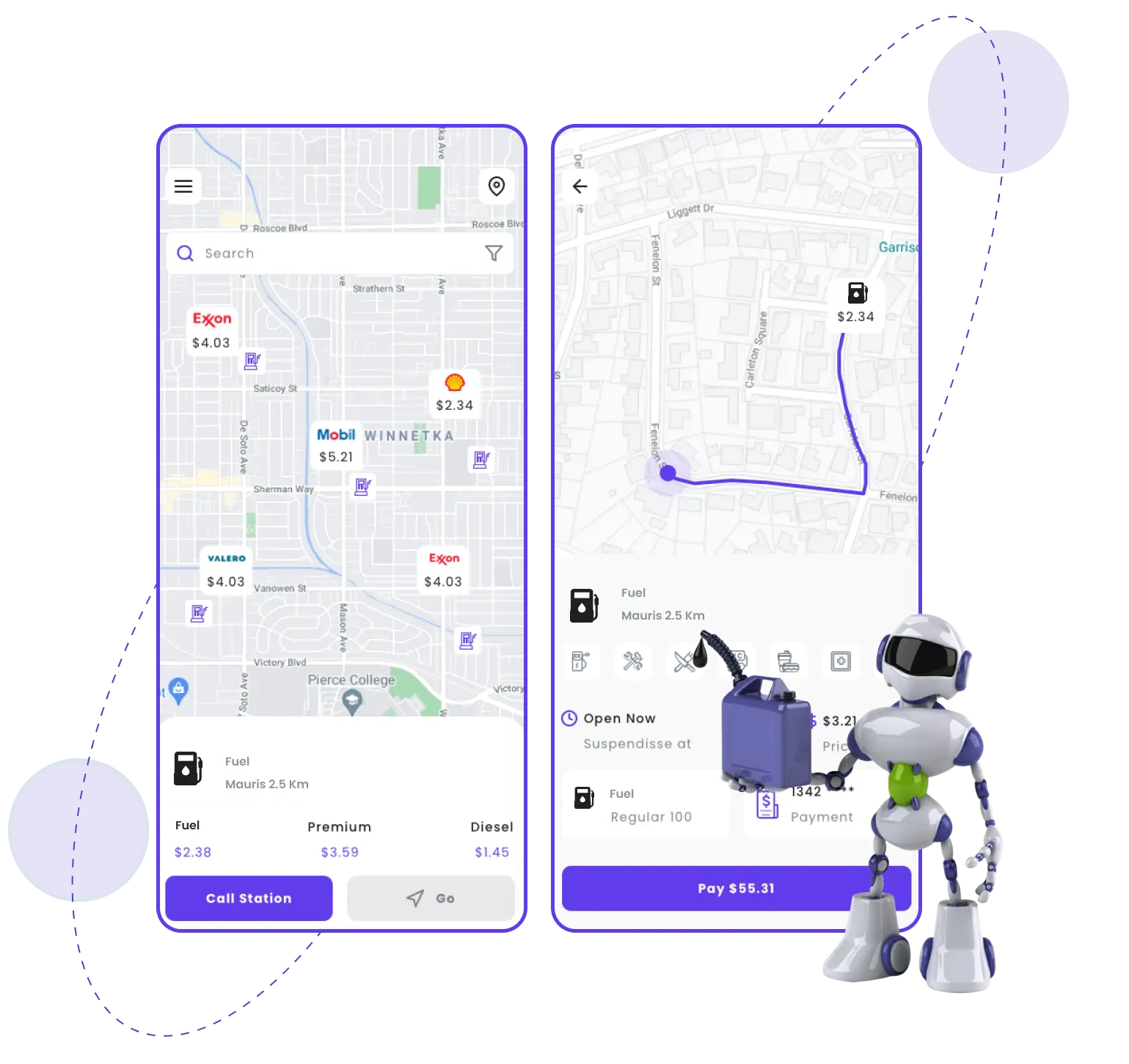
We build fuel station finder apps that help users locate the nearest petrol pump, diesel station, or EV charging point. Integrated with GPS, live pricing updates, and turn-by-turn directions, these apps improve convenience for travelers and vehicle owners.
GPS station locator with filters
Live fuel price updates
Map integration and navigation handoff
Fuel delivery is shifting from phone calls to apps. The global mobile fuel delivery market is worth $6.2 billion in 2026 and should reach $10.1 billion by 2033, growing at 7.3% a year. North America drives about 42% of that revenue, and diesel holds 62% of it. Fleet and industrial customers are usually the fastest, steadiest route to revenue in year one.
Faster ordering and dispatch: Orders arrive, get assigned, and get tracked without a phone call
Wider reach without more staff: One platform covers more zones than a manual dispatch desk
Lower cost per delivery: Route optimization cuts fuel and labor waste on every run
More repeat orders: Live tracking and saved cards turn one-time buyers into weekly ones
Data you can price against: Order history shows which zones and customers actually pay
Fuel delivery margins are thin. These features exist to widen them.
Routes recalculate against live traffic, road closures, and weather so a driver fits more stops into the same shift.
Order history and local patterns predict where volume will land next week, so trucks are positioned before the orders come in rather than after.
Transactions get screened for unusual patterns, which matters when a single fraudulent bulk order can wipe out a day's margin.
Speed, idle time, and route adherence roll into a per-driver score you can act on.
A chatbot handles order status, rescheduling, and refund questions, and hands the complicated ones to a human with full context attached.
Dashboards showing high-demand zones, repeat-customer behavior, and delivery performance, so pricing and coverage decisions come from data instead of instinct.
A fuel delivery app in the US typically runs $25,000 to $150,000, depending on how many apps you need, which features go in version one, and how much compliance logic sits behind the ordering flow.
| Build tier | What's included | Cost range | Timeline |
|---|---|---|---|
| MVP | One platform (iOS or Android), customer app, driver app, admin panel, GPS tracking, card payments, order history | $25,000 – $45,000 | 10 – 14 weeks |
| Full platform | Both platforms, vendor panel, dispatch engine, route optimization, zone pricing, scheduled and recurring orders, analytics | $60,000 – $120,000 | 16 – 24 weeks |
| Enterprise | Multi-state operations, IoT tank sensors, ERP and fleet-system integrations, dynamic pricing, custom compliance workflows, SLA support | $150,000+ | 24 weeks+ |
| White-label | Our existing fuel delivery platform, rebranded, configured, and deployed to your stores | From $18,000 | 4 – 6 weeks |
Pick the model before you pick the feature list. The model decides your unit economics, your permit exposure, and half your app architecture.
Individual customers order petrol or diesel to a home, office lot, or wherever the car is parked. Revenue comes from a per-delivery convenience fee, usually $5 to $10 in US markets, sometimes waived on a subscription.
Best for: urban and suburban launches where parking density is high. What the app needs: fast reorder, saved vehicles, delivery windows, tight ETA accuracy.
Trucking companies, construction sites, rental fleets, and last-mile delivery operators get refueled overnight while vehicles sit idle. Margins are thinner per gallon but volume is steady and churn is low.
Best for: operators with tanker capacity and an existing fuel supply relationship. What the app needs: bulk scheduling, per-vehicle fuel logs, cost-center reporting, net terms invoicing, IoT tank alerts.
Your platform doesn't own trucks. It connects independent fuel vendors with customers and takes a commission on each order, typically 10 to 20 percent.
Best for: asset-light launches and markets where several small fuel suppliers already operate. What the app needs: vendor onboarding, commission engine, payout scheduling, vendor ratings, dispute resolution.
Customers pay a flat monthly fee for a set number of fills or unlimited delivery within a zone. Predictable revenue, and it's the model most likely to survive a slow quarter.
Best for: businesses with an existing customer base ready to convert. What the app needs: plan management, usage caps, proration, failed-payment recovery, easy pause and cancel.
Want a platform along the lines of an app already working in your market? Here's where our clients usually start.
Develop an EzFill-like fuel delivery app featuring multi-fuel support, subscription plans, live driver tracking. A common reference point for US B2C launches.
Fleet-first refueling with per-vehicle reporting and overnight delivery windows. Good template for a B2B model.
Fuel plus adjacent vehicle services like oil changes and tire checks, all in one subscription. Useful if you plan to expand past fuel.
Build an on-demand fuel delivery app like CAFU that enables doorstep fuel delivery with GPS navigation and clean payment flows. Widely referenced by startups in the Gulf and increasingly in US pitches.
Petrol and diesel delivery with order scheduling, driver management, and automated notifications.
Launch a PetroApp-like fuel delivery solution with essential features such as fuel ordering, real-time tracking, and secure digital payments. Our fuel delivery clone app development solution helps you go live quickly with a scalable and cost-effective platform.
Four connected products, built to work as one system.
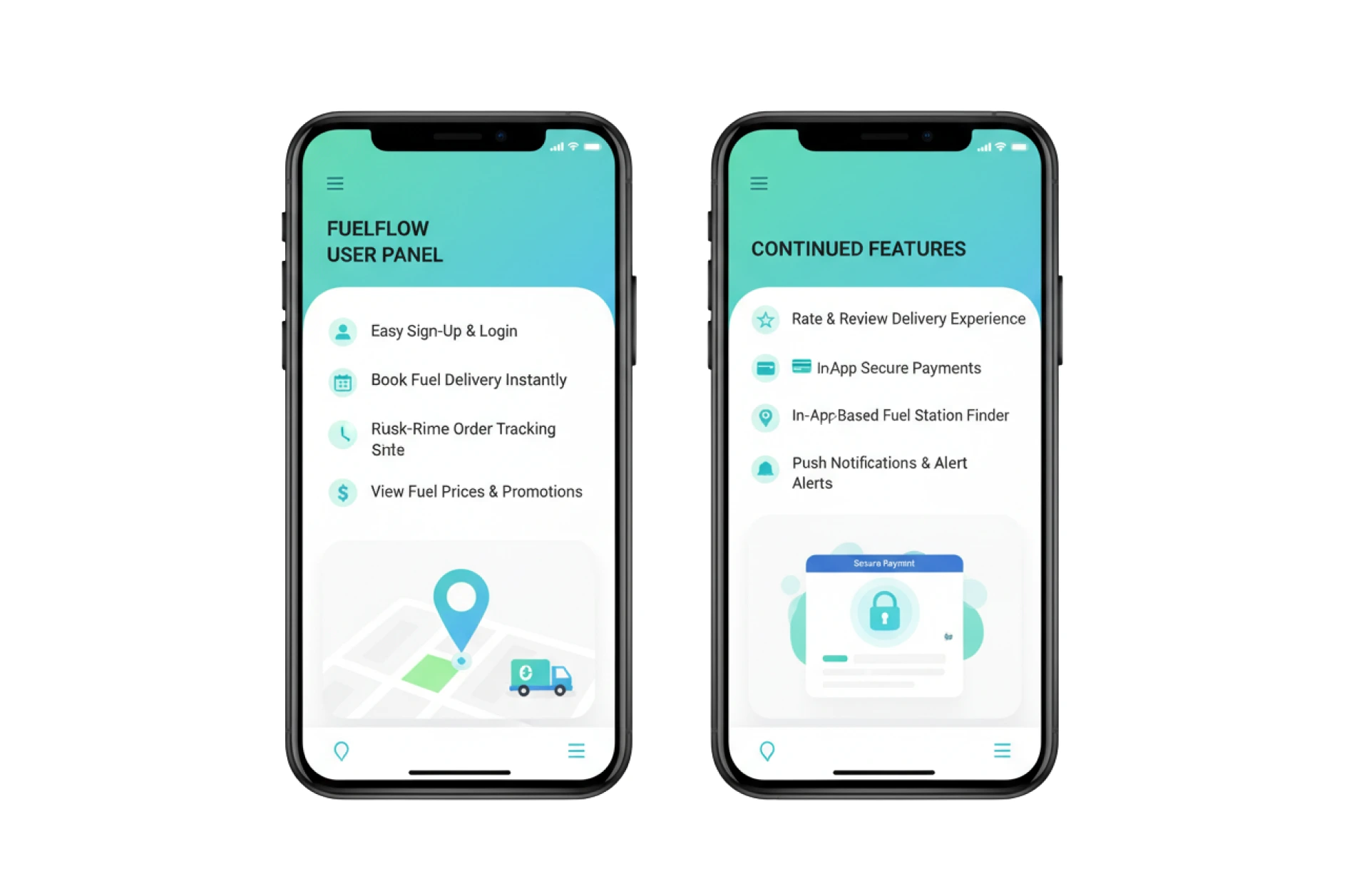
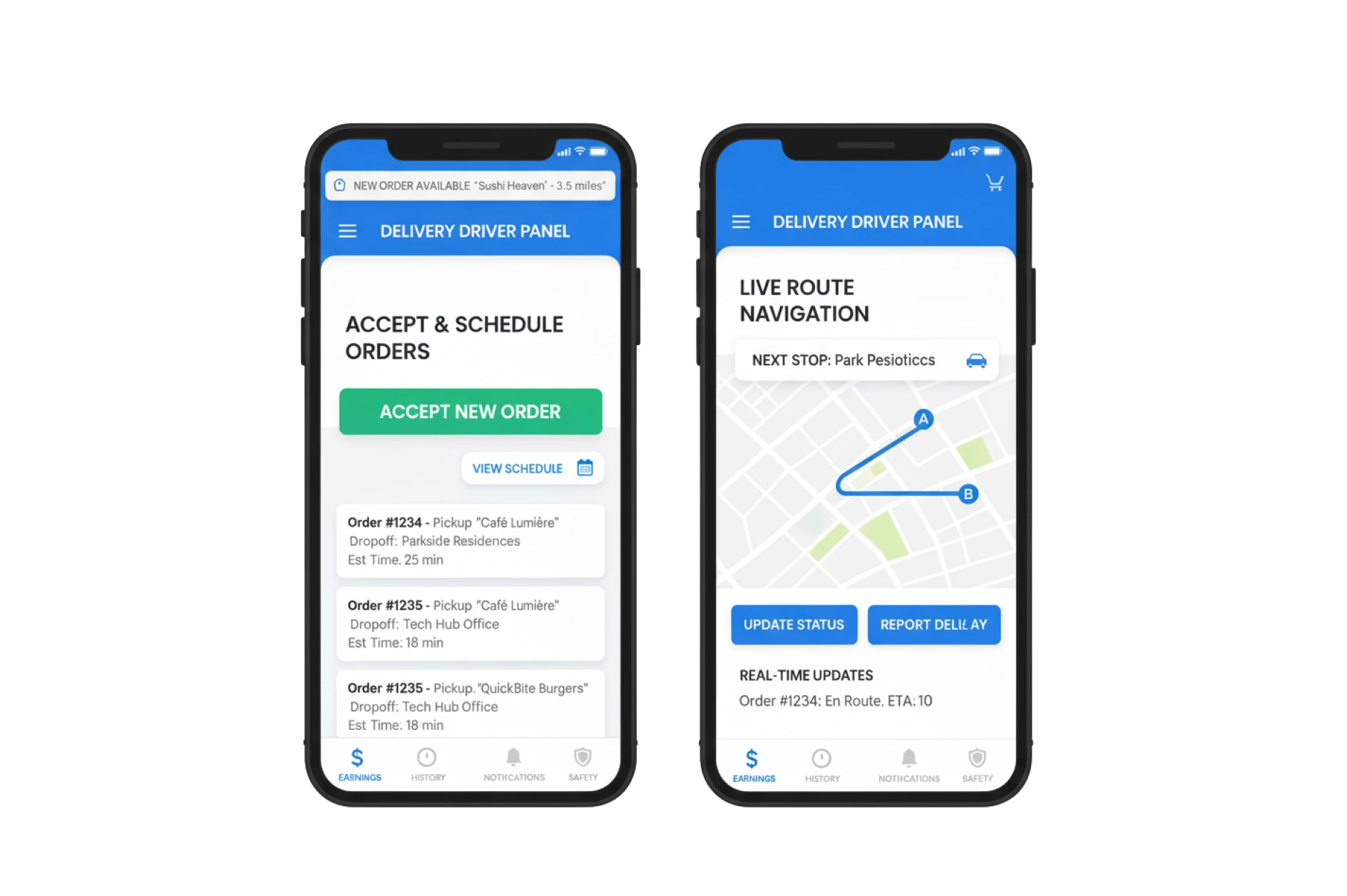
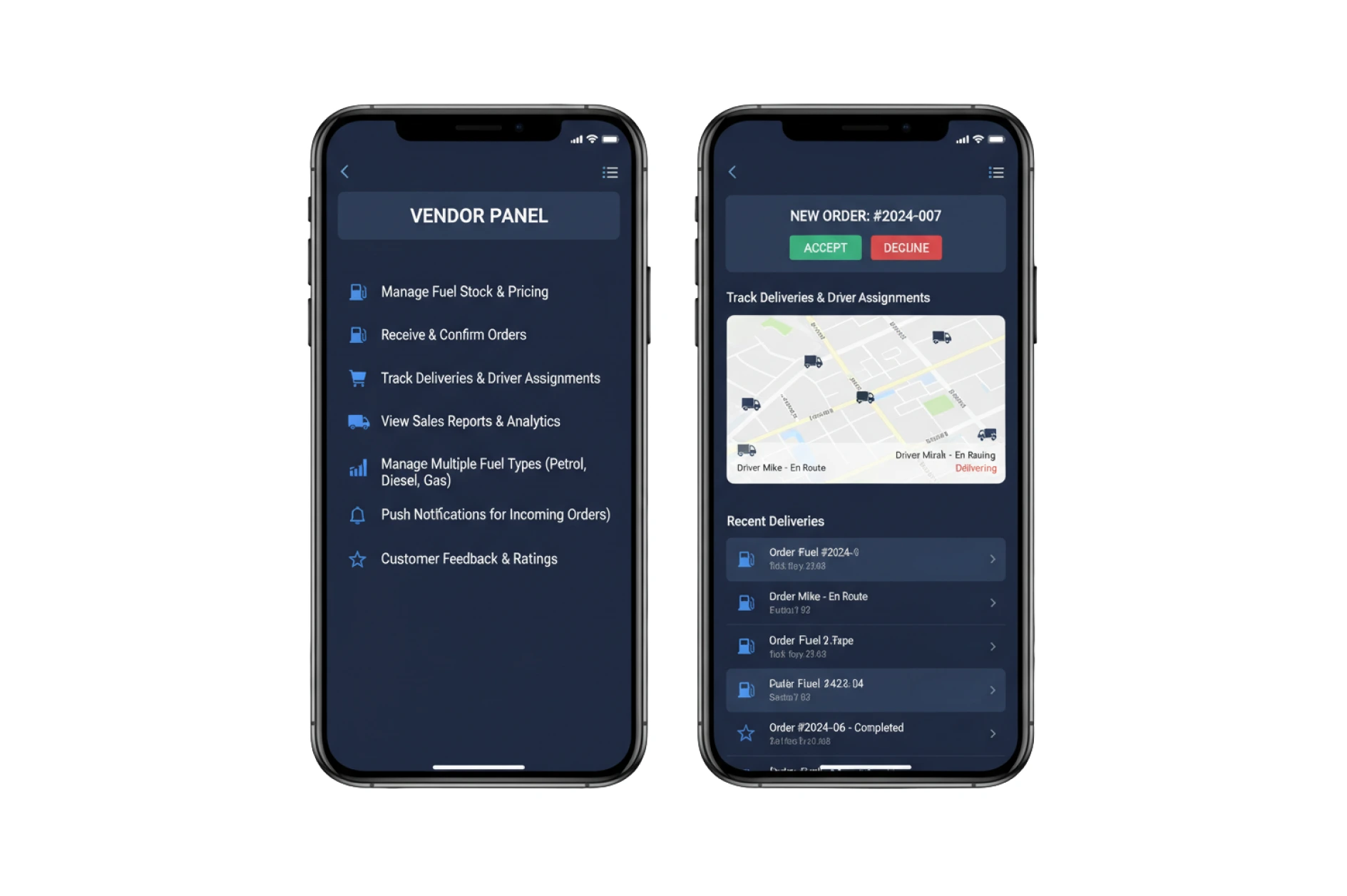
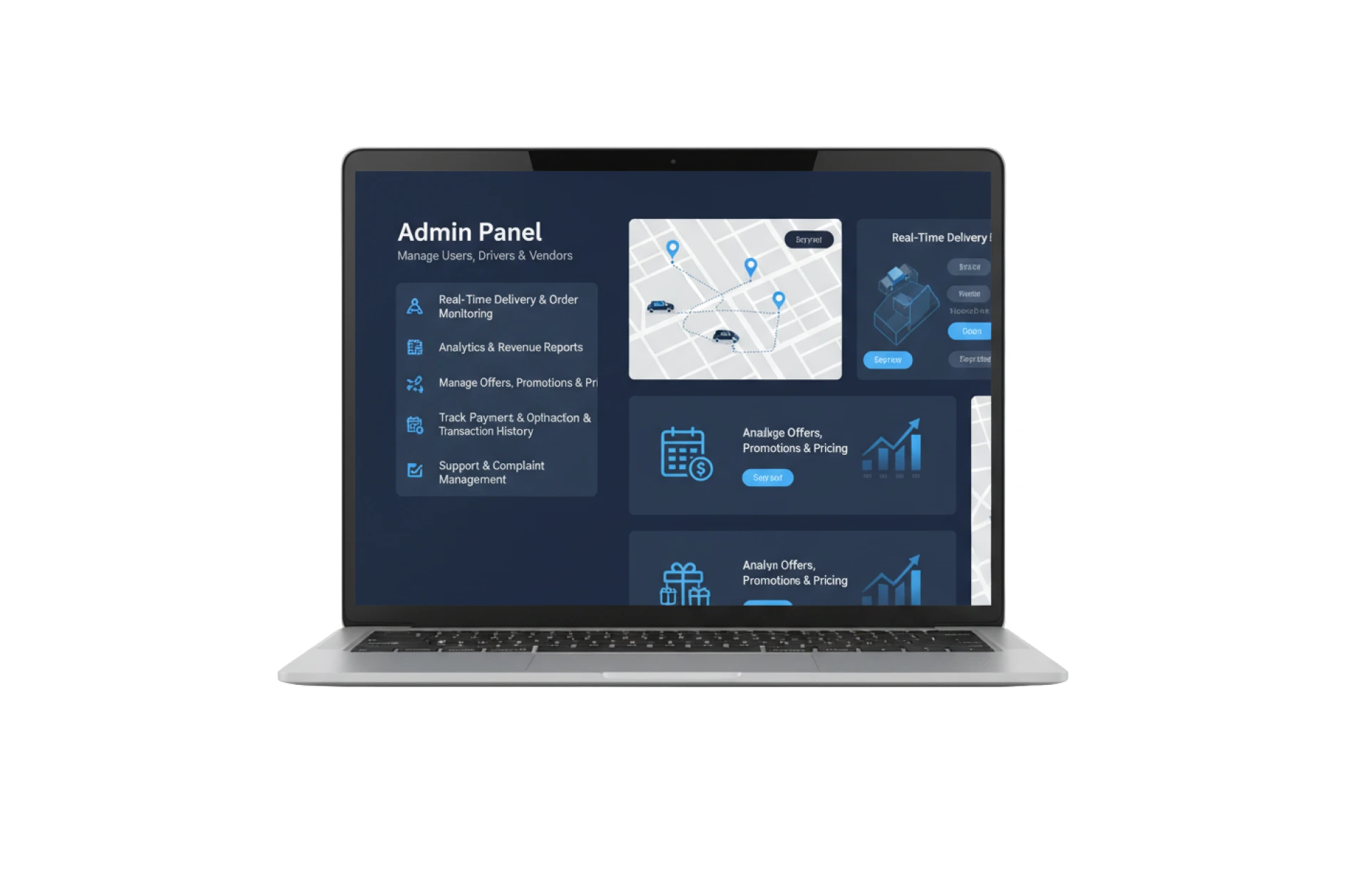
Create a feature-rich fuel delivery solution that improves customer experience while helping your business grow consistently.

Seven stages, each with a clear output before the next one starts. No guessing what's done and what's pending.
Your model, target states, permit status, and must-have features go into a written scope with a fixed estimate. Usually one to two weeks.
Wireframes then high-fidelity screens for all four panels. You sign off before a line of production code gets written.
Core ordering, tracking, dispatch, and payments. Enough to run real deliveries in one city and learn from actual customers.
Vendor panel, zone pricing, subscriptions, analytics, compliance logging, and whatever the MVP taught you was missing.
Functional, load, and security testing across Android, iOS, and web, plus a check that delivery logs export cleanly for audits.
Store submission, backend configuration, and monitoring through the first two weeks of live orders.
Bug fixes, OS updates, feature releases, and performance work on a retainer that matches your volume.
Compliance isn't just paperwork sitting in a drawer. Handled properly, it lives in the product:
Delivery zones locked to the states, emirates, provinces, or districts where your permits are valid.
Driver certification expiry tracking, with dispatch automatically blocked for lapsed credentials.
Digital delivery logs with gallons, timestamp, GPS coordinates, and vehicle ID, retained for instant audit exports.
Pre-trip vehicle inspection checklists integrated directly inside the driver app.
Incident and spill reporting workflow that generates an immediate, filable compliance record.
Our team builds these as first-class features, not afterthoughts. If an inspector asks for six months of delivery records, in any of these markets, you should be able to export them in under a minute.
Fuel delivery apps carry real-time load, payment sensitivity, and audit requirements at the same time. The stack reflects that.
 nextjs
 React js
 Angular js
 Javascript
 Typescript
 React Native
 Flutter
 Swift (iOS)
 Kotlin (Android)
 Nodejs
 Express js
 Django
 Python
 Java (Spring Boot)
 PHP (Laravel)
 PostgreSQL
 MongoDB
 MySQL
MySQL Redis
Redis Google Maps API
 Mapbox
 Geolocation APIs
 AWS
AWS GCP
GCP Docker
 Microsoft Azure
 Kubernetes
 Razorpay
 Stripe
 PayPal
 Apple Pay
 PayTabs
 Klarna
 End-to-End Encryption
 OAuth Authentication
 JWT Authentication
Picking the right delivery app development partner decides whether your fuel delivery app actually works at launch or breaks under real traffic. Here's why startups, enterprises, and fuel service providers across the USA, India, UAE, UK, Canada choose Comfygen.

Comfygen has shipped delivery app platforms across food, grocery, medicine, courier, water, and fuel. Dispatch logic, live tracking, and driver payouts are problems our team has solved repeatedly, not learned on your budget.
Delivery zone locking, driver certification tracking, and audit-ready logs go into the architecture at the start, because retrofitting them later means touching every panel.
Itemized estimates broken out by panel and sprint. Third-party API costs listed separately so you know what's a build cost and what's a running cost.
Two-week sprints, a demo at the end of each one, and a dedicated project manager you can actually reach.
Launch fast on our existing platform, or build from scratch when your model needs it. Both paths are open, and we'll tell you honestly which one fits.
Monitoring, updates, and feature work on an ongoing basis. The first ninety days after go-live are when fuel delivery apps break, and that's exactly when our team stays closest.
At Comfygen Technologies, we deliver innovative digital solutions for various industries, helping businesses leverage AI, Blockchain, and modern app development.
Need engineers who've built this before rather than a general mobile app development team figuring it out? Comfygen offers dedicated fuel delivery developers on monthly contracts, working in your time zone and reporting into your process.
Dedicated experts in on-demand fuel delivery app development solution
AI-driven route optimization and smart fuel dispatch system
Real-time fuel delivery tracking with GPS integration
End-to-end app development from UI/UX design to deployment

Hear what our clients have to say about their experience working with us
📹 Video URL: https://www.youtube.com/watch?v=kedGnt6T-DI
🖼️ Thumbnail URL: https://www.comfygen.com/comfygen-images/comfygen/nitesh-rajput-testimonial.webp
Book My Tuter
📹 Video URL: https://www.youtube.com/watch?v=-AkHiORQTjA
🖼️ Thumbnail URL: https://www.comfygen.com/comfygen-images/comfygen/sayead-shadab-arif-testimonial.webp
Froge Flex
Vietnam
My overall experience working with the company was very positive. The team demonstrated professionalism and strong technical skills throughout the project. Communication was clear and timely, which helped us stay on schedule. They were responsive to our feedback and flexible in adapting to changes. The final product met all our expectations and was delivered on time. Some minor improvements could be made in the testing phase, but overall, I am very satisfied with the collaboration.
Madison
Sonic Foundry Inc. noted that Confygen consistently fulfilled its commitments and demonstrated strong project management skills, keeping the app's development on track. The client was pleased with the final result.
Atlanta, Indiana
Comfygen Technologies developed and designed a blockchain and a web wallet for a cryptocurrency company. The team built a Proof of Authority blockchain based on Geth and a user-friendly web wallet.
Noida, India
An IT company hired Comfygen to design and build a dating app for both iOS and Android. The team also integrated features, including geolocation-based matching, swipe functionality, and a secure payment system
Jaipur, India
Comfygen Technologies developed and designed a food delivery app for a mobile app and website development company. The team was responsible for creating a user-friendly and scalable mobile app.
Dubai, United Arab Emirates
Comfygen provided software development services for an IT project management company. The team worked on three projects involving blockchain and e-commerce.
Denver, New York
Comfygen built a custom healthcare mobile app for a review writer company. The app included appointment scheduling, patient record management, and a telemedicine feature. The team also worked on its UI.
Denver, New York
I had a great experience working with Comfygen Technologies. The team is professional, responsive, and truly understands client requirements. Their technical expertise and timely delivery made the entire process smooth and stress-free. I’d definitely recommend Comfygen Technologies to anyone looking for reliable and quality IT solutions.
India
The team at Comfygen pvt ltd. is highly knowledgeable and professional. From the initial consultation to the final implementation, they were able to provide expert advice and guidance. Their commitment to excellence and customer satisfaction is truly impressive, and I look forward to working with them again in the future
Oman
Comfygen Private Limited is the best blockchain app development company in India that I have come across in recent years. They can deliver projects within the given timeline and as per our expectations. I recommend everyone to try Comfygen Private Limited services and products.
Germany
Very professional company. Everyone very friendly. The app we developed for us exceeded our expectations. I also think it's very good that the company also has a branch in Germany and that's why the overall communication was very good. We will develop the next project with you again.
Between $25,000 and $150,000. An MVP with a customer app, driver app, and admin panel runs $25,000 to $45,000. A full platform with vendor management, zone pricing, and analytics lands at $60,000 to $120,000. Multi-state enterprise builds with IoT tank monitoring and ERP integration start around $150,000. Final cost depends on how many apps you need, feature depth, and compliance complexity.
An MVP takes 10 to 14 weeks. A full-featured platform takes 16 to 24 weeks. A white-label deployment can go live in 4 to 6 weeks. Timelines assume decisions come back within a couple of days during design sign-off, which is usually the biggest schedule risk.
Most operators need DOT hazmat registration, drivers with a CDL and hazmat endorsement, a local fire marshal permit, and vehicle inspections meeting NFPA 385. State requirements vary considerably, and a few states restrict dispensing into passenger vehicles without a variance. Confirm with your state fire marshal and a licensed attorney before your first delivery.
It's legal in most states, but conditions differ. Some allow only fleet and commercial refueling, others permit consumer delivery with the right permits, and a handful require a specific variance for dispensing in public parking areas. Nothing about this is uniform, so check state by state before you plan a market.
Yes. Our white-label platform starts at $18,000 and deploys in 4 to 6 weeks with your branding, your pricing rules, and your store listings. It's the fastest way to test a market before committing to a custom build.
Customer ordering with fuel type and quantity selection, live GPS tracking, card payments with pre-authorization, driver dispatch, delivery confirmation, and an admin panel for order and pricing control. Everything else, including subscriptions, vendor onboarding, and IoT, can wait for version two.
Yes, and most of our clients end up needing both. The pricing engine stays separate from the ordering flow, so consumer per-delivery fees and fleet contract rates run side by side without conflicting.
Yes, before any scope discussion. Your idea, feature list, and market plan stay confidential.

Abhishek Singh is a Project Manager at Comfygen Technologies, leading mobile app solutions for clients across 7 countries. He has managed 20+ end-to-end builds across delivery, healthcare, finance, education, and ecommerce platforms. His Python background gives him a solid technical grip on what he's managing, and he handles scoping, planning, and delivery to keep every project on track.
We have the knowledge and skills to work on diverse niches with high-performing solutions. Get insights about the tech revolutions and their significance through our updated blogs.

The way people refuel their vehicles is changing fast. Instead of driving to a gas station, waiting in line, and dealing with bad weather, customers now expect fuel to come directly to them, right at their doorstep, office parking, or job site. This shift has turned fuel delivery app development into one of the most […]

The global on-demand economy has fundamentally reshaped how we buy groceries, food, medicine, and now, fuel. The cost to develop a fuel delivery app like CAFU has become one of the most-searched questions among entrepreneurs in 2026, and for good reason. According to Business Research Insights, the global on-demand fuel delivery market is projected to […]

Grocery delivery app development means building a platform with four connected parts: a customer app, a vendor panel, a driver app, and an admin dashboard. A basic build takes 8 to 12 weeks and starts around $15,000. The hardest part is not the ordering flow. It is keeping stock counts accurate and handling items that […]


