


Zepto Clone App Development
A grocery delivery app with 10-minute fulfilment, dark store integration and live inventory management. The Zepto model works on stock density, not rider speed, so the build starts with the inventory layer.

Comfygen is a quick commerce app development company building instant delivery platforms for 10 to 30 minute fulfilment. Every Q-commerce build covers four connected systems: a customer app, a rider app, a dark store panel and a real-time admin dashboard, across grocery, pharmacy, food, FMCG and convenience retail.


Comfygen covers the full stack behind instant delivery, from the customer's first tap to the rider's proof of delivery. Every service below ships as part of a working platform rather than as a standalone module.
Custom quick commerce app development suits operators whose model doesn't match anything already on the shelf: unusual category mixes, existing ERP systems that have to stay, or delivery promises tied to a specific service area. Everything gets built to your workflow rather than bent to fit a template.
Brand-led UI/UX designed around a sub-60-second checkout
Location-based service models with geo-fencing per store
POS, ERP and inventory API integrations
Customer app, rider app and admin dashboard as one connected system

Custom quick commerce app development suits operators whose model doesn't match anything already on the shelf: unusual category mixes, existing ERP systems that have to stay, or delivery promises tied to a specific service area. Everything gets built to your workflow rather than bent to fit a template.
Brand-led UI/UX designed around a sub-60-second checkout
Location-based service models with geo-fencing per store
POS, ERP and inventory API integrations
Customer app, rider app and admin dashboard as one connected system
On-demand quick commerce app development covers platforms where the order arrives first and the fulfilment decision happens in seconds. Order routing, rider assignment and stock checks all run automatically, so your ops team handles exceptions rather than every order.
Instant order acceptance with automatic store selection
Live rider allocation based on distance, load and current task queue
Scheduled and instant delivery slots side by side
Surge handling for lunch and evening peaks
Already know the model you want? Our white label Q-commerce platform gets you to App Store and Play Store submission in six to ten weeks, with your branding on every screen and full source code handed over on delivery.
Pre-built modules for catalogue, checkout, tracking, wallet and admin
Editable themes, logos, colour systems and copy
Codebase ready for multi-city expansion without a rewrite
Same ownership terms as a custom build, no vendor lock-in
Order management is where most quick commerce platforms quietly lose money. Our AI order management layer sends each order to the store that can actually fulfil it fastest, not just the closest one, factoring in picker load, stock accuracy and rider availability. Smart ordering on the customer side predicts the basket a returning user is about to build and pre-loads it, which cuts time-to-checkout on repeat orders.
AI-based order routing across stores and dark stores
Automated dispatch systems with fallback rider assignment
Peak-hour order batching and queue management
Exception handling for partial stock, failed addresses and rider drop-offs
Every order sits in one live state machine: confirmed, picked, dispatched, delivered. Your ops team sees the whole board on one screen with automatic escalation when an order breaches its promised ETA. Customers see the same truth through live tracking, which is the cheapest way to cut "where is my order" support tickets.
Live order board with breach alerts and manual reassignment
Rider GPS tracking with dynamic ETA recalculation
Proof of delivery through photo, OTP or signature
Automated notifications at every state change
Intelligent inventory management keeps one source of truth across every dark store, warehouse and vendor location. Stock moves in real time, so a product that just sold out in one store stops appearing for customers in that delivery zone within seconds rather than at the next scheduled sync.
Multi-warehouse and multi-store stock sync
Batch and expiry tracking for pharmacy and fresh categories
Purchase order and supplier management
Demand forecasting that flags a restock before the shelf empties
Hyperlocal delivery integration is the routing layer between an order and a doorstep. Deliveries auto-assign to the nearest available rider, routes recalculate as traffic changes, and every dark store carries its own delivery radius so you never promise 10 minutes to an address 8 km away.
GPS and mapping API integration through Google Maps or Mapbox
Automatic rider assignment engine with load balancing
Live rider tracking and ETA recalculation
Third-party logistics fallback when your own fleet is saturated
Running your own stock isn't the only route. A multi-vendor quick commerce marketplace lets local kirana stores, pharmacies and cloud kitchens list on your platform while you own the customer relationship and the delivery fleet. That model reaches more postcodes for less capital, since you aren't leasing warehouse space in every one.
Vendor onboarding with KYC, licence upload and category approval
Per-vendor commission rules, payout cycles and settlement reports
Vendor app for order acceptance, stock updates and earnings
Unified basket across several vendors in a single delivery run
Checkout is where quick commerce baskets get abandoned, so payment options get configured per market rather than copy-pasted from the last build. India-facing apps get UPI, Razorpay and cash on delivery. Gulf launches get PayTabs and Apple Pay. US and UK builds get Stripe and PayPal.
In-app wallet with top-up, instant refunds and cashback rules
One-tap checkout with saved payment methods
Split payments across wallet, card and promo credit
PCI DSS-aligned handling, with no card data stored on your servers
The rider app is the piece founders usually underestimate. Riders run it for six hours straight on mid-range Android phones with patchy signal, so ours is built for offline queueing and battery behaviour first, visual polish second.
Task queue, earnings tracker and in-app chat
Offline order caching that syncs when signal returns
Proof of delivery by photo or signature
AI route planning with live ETA recalculation
One Flutter or React Native codebase covers iOS and Android at roughly 30% less than two native builds, and a PWA catches the users who won't install anything. Performance stays close enough to native that customers won't notice the difference at checkout.
Shared codebase with near-native performance
PWA ordering with no app download required
Built to current App Store and Play Store review requirements

The global quick commerce market hit USD 184.55 billion in 2025 and is tracking toward USD 385.36 billion by 2034, with North America holding a 33.43% share. Models it higher still. The forecasts disagree. The direction doesn't
Growth sits in dense urban zones, where a 2 to 3 km radius keeps a dark store profitable. A Q-commerce platform captures it through:
Dark stores that make sub-10-minute delivery possible
AI forecasting that keeps fast-moving SKUs in stock
Live tracking, the biggest driver of repeat orders
Micro-fulfilment that scales one city at a time
Quick commerce works differently in every category. Stock behaviour, compliance load and basket size all change, so the platform changes with them.
Build a grocery delivery app like Zepto or Blinkit, handling thousands of SKUs across multiple dark stores with 10 to 30 minute fulfilment. Milk, bread and eggs sell out between 7am and 10am in almost every market, so replenishment triggers and cut-off logic matter more here than anywhere else. FMCG delivery follows the same architecture with a wider SKU range and higher reorder frequency.
Build a medicine delivery platform in the mould of Tata 1mg or PharmEasy, with prescription validation, batch and expiry tracking, and architecture built to support your HIPAA and GDPR obligations.
Instant food delivery in the Swiggy Instamart mould, covering ready meals, snacks and beverages inside 30 minutes. Cloud kitchens and snack bars get their own panel, and peak-hour batching keeps rider costs sane between 12pm and 2pm.
Phone chargers, earphones, batteries and small accessories now move through the same 10-minute channel as groceries. Higher unit value means the platform needs serial number tracking, stricter fraud checks and a returns flow that groceries never require.
Build a blazing-fast Q-commerce app with Comfygen—trusted experts in real-time delivery app development.

Comfygen builds Q-commerce platforms modelled on the fastest-growing instant delivery apps in the world. Every one is custom-developed rather than templated, and built around your market, brand and operating model
A grocery delivery app with 10-minute fulfilment, dark store integration and live inventory management. The Zepto model works on stock density, not rider speed, so the build starts with the inventory layer.
A hyperlocal grocery and essentials platform covering the full ecosystem: customer app, rider app, warehouse panel and admin dashboard, all synced in real time.
Food and grocery in one basket with instant checkout, route-optimised delivery and peak-hour order management. Suits food-tech operators targeting sub-30-minute delivery in metro and Tier 2 cities.
A micro-fulfilment platform for Western markets, covering FMCG delivery, subscriptions and a dark store operations panel.
Multi-category hyperlocal delivery handling groceries, medicines and personal errands on one platform. Built for dense urban markets where the same rider fleet serves several verticals.
Healthcare Q-commerce with doctor consultations, e-prescription upload, same-day medicine delivery and lab test booking, built to your pharmacy licensing requirements.
The European convenience model: a tight SKU range, high order frequency and delivery windows measured in minutes rather than hours.

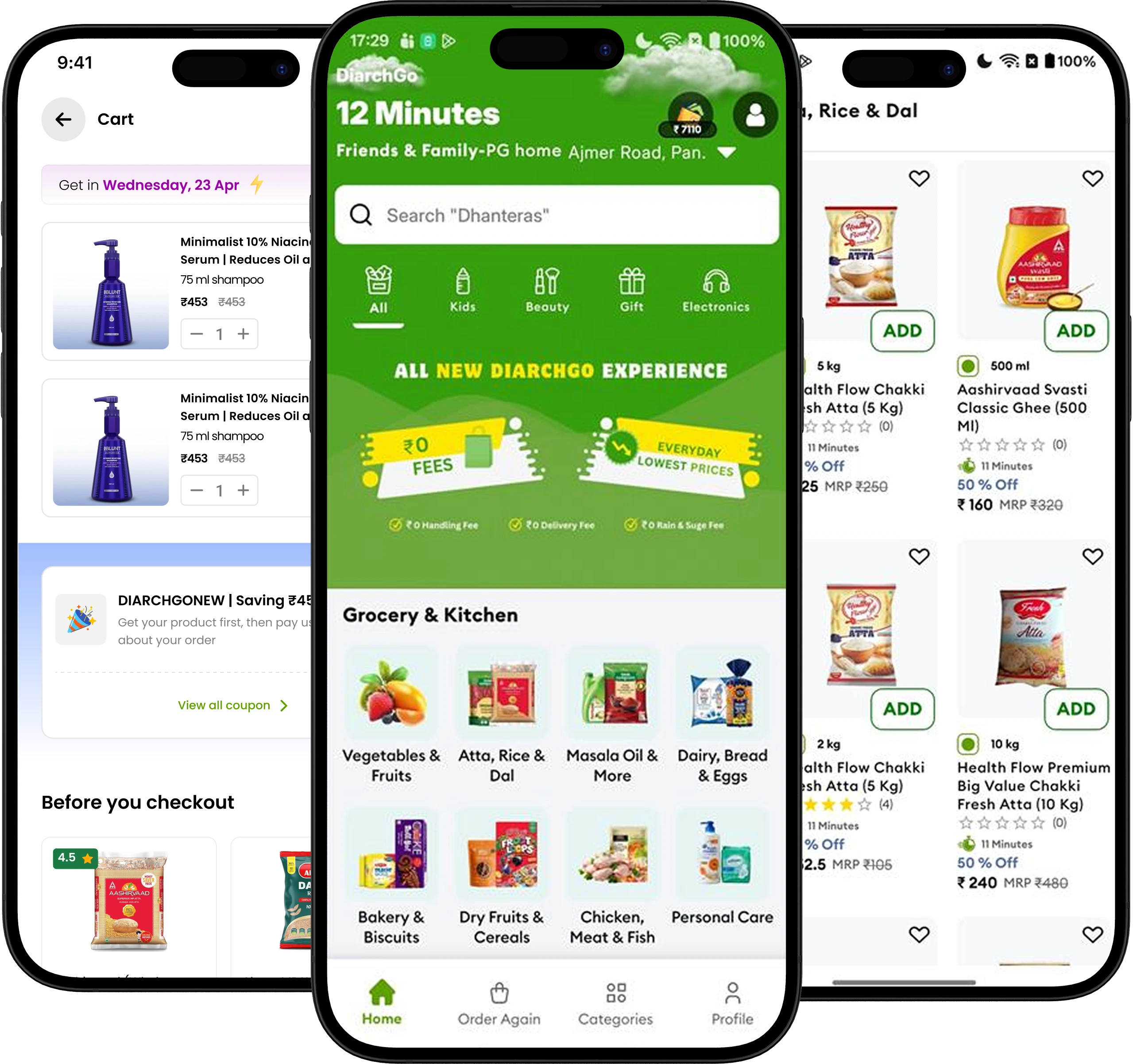


Comfygen developed DiarchGo, an advanced grocery delivery app with modern features to provide seamless, and reliable access to quick commerce services.
Case StudyAI earns its place in a Q-commerce platform when it moves a number you can see on a dashboard.
The recommendation engine reads purchase history, location, time of day and trending items to surface the right products for each shopper. In grocery, the biggest lift usually comes from reorder prediction rather than discovery, because most baskets repeat.
Order status, refund requests and delivery complaints are the three questions that fill a support inbox. An NLP chatbot handles those around the clock, so your team only sees what genuinely needs a human.
The routing engine computes the fastest path in real time using traffic, rider availability, order volume and distance from the dark store. Fewer failed deliveries, lower fuel spend and ETAs that hold up during rush hour.
Models read historical sales, seasonal patterns and local demand signals to predict which products will spike before they run out, which means fewer cancelled orders in the categories that empty first.
The analytics layer tracks purchase frequency, session behaviour and churn risk signals, so you can run targeted promotions, recover at-risk customers and adjust the catalogue by location rather than by guess.
Transactions get scored in real time for suspicious patterns, catching payment fraud, fake accounts and promo abuse without adding friction for genuine customers.
Comfygen Technologies develops next-generation quick commerce applications using cutting-edge technologies. In high-speed businesses like groceries, medicine, food, and essentials, we offer solutions that enable ultra-fast delivery, intelligent automation, and real-time operational efficiency.

We build AI and ML-based quick commerce apps to create personalized shopping experiences with features like dynamic product recommendations, demand forecasting, smart inventory replenishment, and customer behavior analysis. AI chatbots handle real-time queries, streamline order support, and improve customer satisfaction.

Our Q-commerce platforms include intelligent recommendation engines that analyze browsing history, location, and order behavior to suggest relevant products—boosting cart value, conversions, and repeat orders.

We integrate IoT into quick commerce apps to enable real-time vehicle tracking, smart warehousing, and automated alerts. This helps reduce delivery time, optimize routes, and ensure transparency from warehouse to doorstep.

Our Q-commerce mobile apps are built on robust cloud infrastructure with a microservices-based architecture that ensures scalability, real-time syncing of inventory, and seamless multi-location operations. This helps manage high volumes with uninterrupted service.

We develop blockchain-based quick commerce apps to secure payments, loyalty points, and digital contracts between vendors, delivery partners, and customers. It ensures transparent operations, fraud prevention, and tamper-proof delivery and payment records.

Our Q-commerce apps leverage big data to monitor user trends, forecast demand spikes, and optimize inventory levels in real-time. These insights empower business owners to make smarter decisions and run more efficient, profitable operations.

We deploy RPA bots to automate repetitive backend tasks like order assignment, stock updates, and customer notifications. This reduces manual errors and speeds up operational workflows in high-demand environments.

We integrate AR into Q-commerce apps to enable users to virtually try products like cosmetics, accessories, or furniture before purchase. This enhances customer confidence, reduces return rates, and offers a highly engaging, immersive shopping experience.
Our quick commerce apps are built to deliver speed, convenience, and intelligence. With a feature-rich architecture, we help businesses offer lightning-fast delivery experiences, streamline backend workflows, and boost user engagement in the high-demand Q-commerce market.
Seven stages, two-week sprints, working software you can open at the end of every one.
Business goals, target market and competitor review come first, along with the delivery radius maths that decides whether your model works before anyone designs a screen.
Our design team maps user flows around speed. In quick commerce, every extra tap between search and checkout costs conversions.
Framework, database and infrastructure decisions get made against your expected order volume and city count, not against a default template.
Our Q-commerce developers work in two-week sprints with continuous testing. You get a build to open every fortnight rather than a demo at the end.
Maps, payments, wallets, POS and CRM connections get built and tested against live sandbox environments.
Load testing simulates peak-hour order volume, because a platform that works at 20 orders an hour and falls over at 400 isn't finished.
Store submission, launch monitoring, then 30 days of free bug fixes and structured maintenance plans after that.
The build implication: an e-commerce platform optimises for discovery, a quick commerce platform optimises for fulfilment certainty. Porting one to the other rarely works, which is why most operators moving from e-commerce into Q-commerce end up rebuilding the inventory and dispatch layers from scratch.
| Dimension | E-commerce | Quick commerce |
|---|---|---|
| Delivery window | 1 to 7 days | 10 to 30 minutes |
| Fulfilment site | Central warehouse | Dark store 2 to 3 km from the customer |
| Catalogue size | 50,000+ SKUs | 1,500 to 4,000 SKUs |
| Inventory sync | Periodic batch updates | Real time, deducted on order confirmation |
| Typical basket | Larger, less frequent | Smaller, several times a week |
| Delivery fleet | Third-party couriers | Own or contracted riders on short routes |
| Core tech challenge | Catalogue and search at scale | Order routing and live stock accuracy |
Comfygen builds secure, scalable, and feature-rich Quick-Commerce apps using modern technologies. Our advanced tech stack ensures smooth shopping experiences, secure payments, real-time tracking, and seamless performance across mobile and web platforms.
 React Native
 Flutter
 Swift (iOS)
 Kotlin (Android)
 React js
 Angular js
 Javascript
 HTML5
HTML5 CSS3
CSS3 Nodejs
 Express js
 Django
 Python
 Java (Spring Boot)
 PHP (Laravel)
 PostgreSQL
 MongoDB
 MySQL
MySQL Redis
Redis Google Maps API
 Mapbox
 Geolocation APIs
 AWS
AWS GCP
GCP Docker
 Microsoft Azure
 Kubernetes
 Razorpay
 Stripe
 PayPal
 Apple Pay
 PayTabs
 Digital Wallets
Quick commerce platforms handle addresses, payment tokens and sometimes prescriptions, so security isn't a phase bolted on at the end. Comfygen holds ISO 9001:2015, ISO/IEC 20000-1:2018 and ISO 27001 certification, and the same controls apply to client projects.
Plenty of studios build apps. Far fewer have shipped the operational layer underneath one.

Grocery, food, pharmacy, fuel, courier and logistics platforms, 550+ projects delivered and a 97% client retention rate. Most of what goes wrong in a Q-commerce build has gone wrong on someone else's project first, and our team has usually seen it.
Developers, architects and designers who work on instant delivery platforms specifically, which is why conversations start at dark store radius rather than at colour palettes.
Two-week sprints, weekly updates, live dashboards and direct access to the people writing the code. No account manager relaying questions.
Complete source code ownership on delivery, NDA protection, encrypted communication and zero vendor lock-in.
Microservices, Docker and Kubernetes with auto-scaling infrastructure, so the platform handles a Friday evening peak the same way it handles a Tuesday morning.
30 days of free bug fixes, then structured maintenance covering performance monitoring, OS and API updates, security patches and new features.
Hire Q-commerce app developers who've built the model before. Our team has shipped platforms in the mould of Zepto, Blinkit, Swiggy Instamart and Tata 1mg, combining live GPS, AI order routing and dark store inventory into one working system.
Specialists in hyperlocal and instant delivery architecture
Grocery, pharmacy, food, FMCG and electronics categories
Live tracking, wallets, reordering and multi-vendor experience
Available on monthly contracts, full time or part time

Hear what our clients have to say about their experience working with us
📹 Video URL: https://www.youtube.com/watch?v=kedGnt6T-DI
🖼️ Thumbnail URL: https://www.comfygen.com/comfygen-images/comfygen/nitesh-rajput-testimonial.webp
Book My Tuter
📹 Video URL: https://www.youtube.com/watch?v=-AkHiORQTjA
🖼️ Thumbnail URL: https://www.comfygen.com/comfygen-images/comfygen/sayead-shadab-arif-testimonial.webp
Froge Flex
Vietnam
My overall experience working with the company was very positive. The team demonstrated professionalism and strong technical skills throughout the project. Communication was clear and timely, which helped us stay on schedule. They were responsive to our feedback and flexible in adapting to changes. The final product met all our expectations and was delivered on time. Some minor improvements could be made in the testing phase, but overall, I am very satisfied with the collaboration.
Madison
Sonic Foundry Inc. noted that Confygen consistently fulfilled its commitments and demonstrated strong project management skills, keeping the app's development on track. The client was pleased with the final result.
Atlanta, Indiana
Comfygen Technologies developed and designed a blockchain and a web wallet for a cryptocurrency company. The team built a Proof of Authority blockchain based on Geth and a user-friendly web wallet.
Noida, India
An IT company hired Comfygen to design and build a dating app for both iOS and Android. The team also integrated features, including geolocation-based matching, swipe functionality, and a secure payment system
Jaipur, India
Comfygen Technologies developed and designed a food delivery app for a mobile app and website development company. The team was responsible for creating a user-friendly and scalable mobile app.
Dubai, United Arab Emirates
Comfygen provided software development services for an IT project management company. The team worked on three projects involving blockchain and e-commerce.
Denver, New York
Comfygen built a custom healthcare mobile app for a review writer company. The app included appointment scheduling, patient record management, and a telemedicine feature. The team also worked on its UI.
Denver, New York
I had a great experience working with Comfygen Technologies. The team is professional, responsive, and truly understands client requirements. Their technical expertise and timely delivery made the entire process smooth and stress-free. I’d definitely recommend Comfygen Technologies to anyone looking for reliable and quality IT solutions.
India
The team at Comfygen pvt ltd. is highly knowledgeable and professional. From the initial consultation to the final implementation, they were able to provide expert advice and guidance. Their commitment to excellence and customer satisfaction is truly impressive, and I look forward to working with them again in the future
Oman
Comfygen Private Limited is the best blockchain app development company in India that I have come across in recent years. They can deliver projects within the given timeline and as per our expectations. I recommend everyone to try Comfygen Private Limited services and products.
Germany
Very professional company. Everyone very friendly. The app we developed for us exceeded our expectations. I also think it's very good that the company also has a branch in Germany and that's why the overall communication was very good. We will develop the next project with you again.
A single-city MVP with a customer app, rider app, admin panel, payments and live tracking runs $25,000 to $45,000. A growth build with dark store inventory sync, wallets and a vendor panel runs $50,000 to $90,000. A multi-city platform with AI routing, demand forecasting and ERP integrations runs $120,000 to $250,000+. Team location, platform choice and integration count are the three biggest cost drivers.
An MVP takes 8 to 12 weeks. A growth build takes 14 to 18 weeks. A full multi-city platform takes 20 to 30 weeks. Development runs in two-week sprints, so you get working software every fortnight rather than one delivery at the end.
Yes. Our QCommerce development team has built Q-commerce platforms modelled on Zepto, Blinkit, Swiggy Instamart, GoPuff, Dunzo and Tata 1mg. Every one is custom-developed rather than templated, and includes a customer app, rider app, warehouse panel and admin dashboard. See[ ](https://www.comfygen.com/blog/build-quick-commerce-app-like-blinkit-zepto-instamart/)[**how we build them**](https://www.comfygen.com/blog/build-quick-commerce-app-like-blinkit-zepto-instamart/) for the full process breakdown.
A dark store is a small warehouse stocked with 1,500 to 4,000 fast-moving items, located two to three kilometres from the customers it serves and closed to the public. It's what makes sub-10-minute delivery physically possible. Comfygen builds the full software layer: bin-level inventory mapping, live stock deduction, batch picking, automated replenishment and store-level cut-off logic.
Yes. Our white label Q-commerce platform includes catalogue, checkout, tracking, wallet and admin panel out of the box, and reaches store submission in six to ten weeks. Branding, themes and colours are fully editable, and you get full source code ownership on delivery, the same as a custom build.
Yes. A multi-vendor Q-commerce marketplace lets local stores, pharmacies and cloud kitchens list on your platform while you keep the customer relationship and the delivery fleet. The build covers vendor onboarding with KYC, per-vendor commission and payout rules, a vendor app, and a unified customer basket across several vendors in one delivery run.
Yes. Our development team of q-commerce has connected Q-commerce platforms to Shopify, WooCommerce, SAP, custom POS systems and third-party inventory tools. The integration layer keeps stock, orders and customer records in sync both ways.
Yes. Medicine Q-commerce builds include e-prescription upload and pharmacist verification, batch and expiry tracking, live medicine availability, doctor consultation booking and secure payments. The architecture is built to support your HIPAA and GDPR obligations as a covered entity.
React Native or Flutter for mobile, Node.js or Python with Django for the backend, PostgreSQL or MongoDB for data, Redis and Firebase for real-time features, and AWS or GCP for infrastructure. Google Maps or Mapbox handle tracking, and payments run through Razorpay, Stripe, PayPal, Apple Pay or PayTabs depending on your market.

Abhishek Singh is a Project Manager at Comfygen Technologies, leading mobile app solutions for clients across 7 countries. He has managed 20+ end-to-end builds across delivery, healthcare, finance, education, and ecommerce platforms. His Python background gives him a solid technical grip on what he's managing, and he handles scoping, planning, and delivery to keep every project on track.
We have the knowledge and skills to work on diverse niches with high-performing solutions. Get insights about the tech revolutions and their significance through our updated blogs.
Quick commerce app development means building four connected systems: a customer app, a rider app, a dark store panel, and an admin dashboard that keeps them synced in real time. Costs run $25,000 to $45,000 for a single-city MVP and $120,000 to $250,000+ for a multi-city platform. Timelines run 8 to 30 weeks depending on […]

Quick Summary: The cost to develop an app like Zepto ranges from $25,000–$45,000 for a single-city MVP to $250,000 and above for a multi-city quick commerce platform. Most founders underestimate this because Zepto is not one app — it is an ecosystem of four to five connected applications. Your final number depends on how many […]
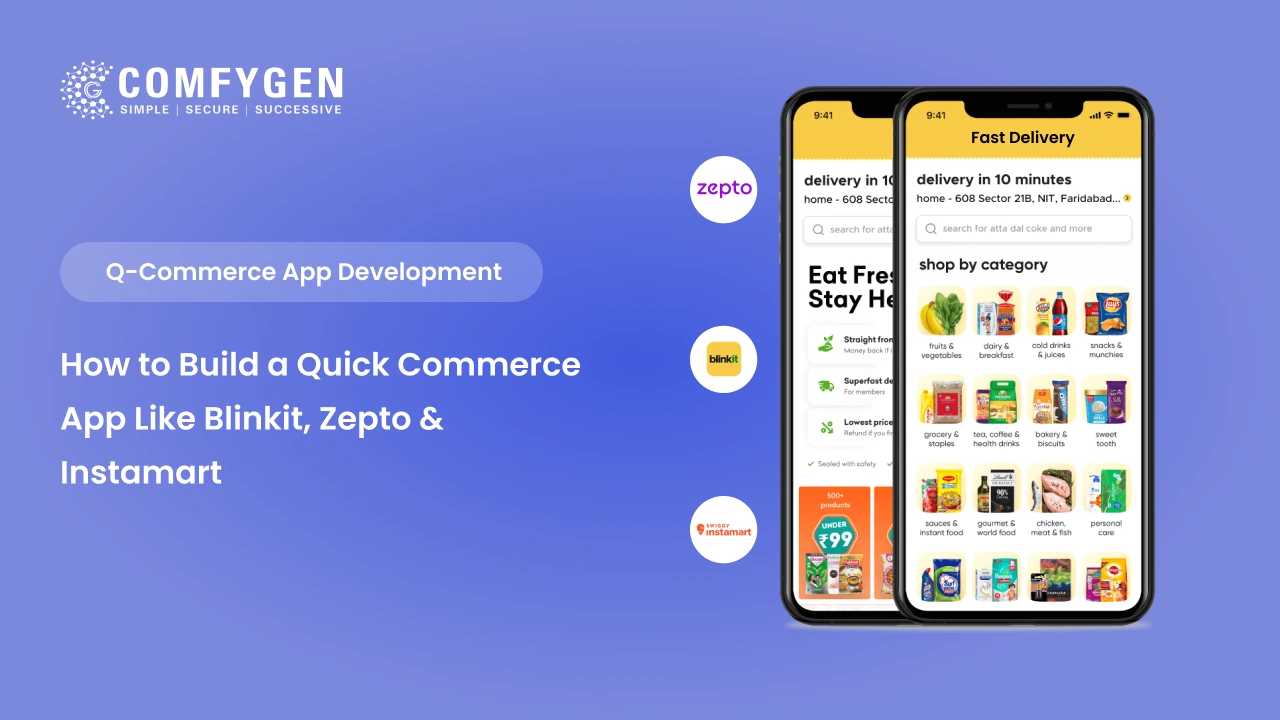
The demand for instant delivery services has changed the way people shop for groceries and everyday essentials. Consumers now expect products to arrive within 10–30 minutes, creating a massive opportunity for businesses to enter the quick commerce market. The global online grocery market is expected to reach $2.1 trillion by 2030, growing at a fast […]


